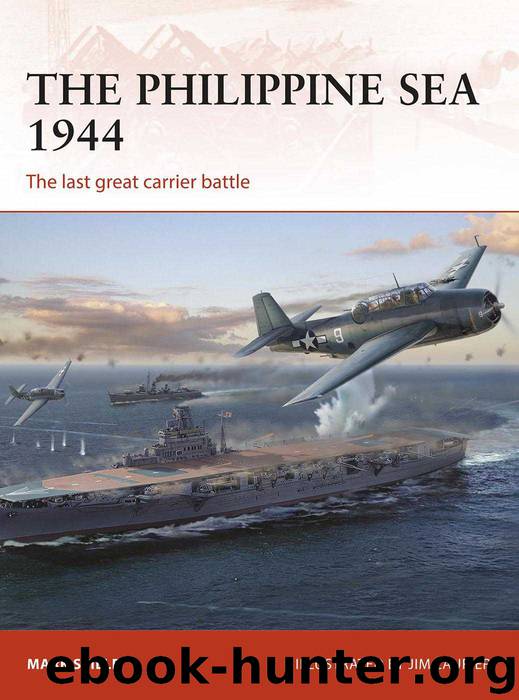
The Philippine Sea 1944: The last great carrier battle (Campaign) by Mark Stille
Author:Mark Stille [Stille, Mark]
Language: eng
Format: azw3
ISBN: 9781472819222
Publisher: Bloomsbury Publishing
Published: 2017-09-21T04:00:00+00:00
Assessment of Operation A-Go
By 1944, the IJN was dealing from a position of severe weakness. The A-Go plan was like pre-war IJN plans for a decisive battle, but in 1944 the conditions necessary for success simply did not exist. It is debatable if they ever did even when the IJN was at the height of its preparedness before the war. The pillars that A-Go depended upon were unsteady at best and already in a state of collapse at worst. The plan depended on the massive application of airpower, and it was here that the Japanese were weakest. The Base Air Force was unable to carry out its reconnaissance duties, allowing the Americans to achieve operational and tactical surprise. This caught the Base Air Force out of position and gave the First Mobile Fleet a late start to intervene in the battle. More disastrously, the Base Air Force was unable to conduct anything like successful attacks against the USN’s carriers force, thus undermining a key premise of the plan to inflict severe attrition on the USN. This should not have been a surprise to the Japanese since the ability of the USN’s Fast Carrier Task Force to operate within range of Japanese land-based airpower with relative immunity had been demonstrated throughout 1944.
The decisive battle phase was based on a flight of fancy. The Japanese were well aware of the limited capabilities of their carrier aviation units. Besides being outnumbered more than two to one by USN carrier aircraft, the aircrews of the First Mobile Fleet were barely able to perform basic take-off, landing and over-water navigation; their abilities to perform advanced functions like air combat and hitting a maneuvering target at sea were even more suspect. The Japanese were aware of these limitations, but chose to ignore them. Even the notion that the IJN’s surface force could overcome its numerical inferiority to beat the USN’s surface force in a night engagement was based on an outdated notion from the early-war period when the IJN’s night-fighting capabilities were unrivalled. Throughout the Solomons campaign the IJN’s night-fighting edge had eroded as the USN successfully learned to employ radar in night actions and to fully exploit the offensive capabilities of its destroyers. The very idea that the USN would allow itself to be caught in a night engagement with the IJN under unfavorable tactical circumstances was ridiculous.
In conclusion, there was very little prospect that A-Go would end successfully for the Japanese. The superiority of the USN in all aspects of naval warfare was simply too great by this period of the war.
Download
This site does not store any files on its server. We only index and link to content provided by other sites. Please contact the content providers to delete copyright contents if any and email us, we'll remove relevant links or contents immediately.
| Africa | Americas |
| Arctic & Antarctica | Asia |
| Australia & Oceania | Europe |
| Middle East | Russia |
| United States | World |
| Ancient Civilizations | Military |
| Historical Study & Educational Resources |
The Sympathizer by Viet Thanh Nguyen(4446)
The Rape of Nanking by Iris Chang(4264)
World without end by Ken Follett(3512)
Ants Among Elephants by Sujatha Gidla(3495)
Blood and Sand by Alex Von Tunzelmann(3241)
Japanese Design by Patricia J. Graham(3218)
The Queen of Nothing by Holly Black(2658)
City of Djinns: a year in Delhi by William Dalrymple(2580)
India's Ancient Past by R.S. Sharma(2493)
Foreign Devils on the Silk Road: The Search for the Lost Treasures of Central Asia by Peter Hopkirk(2482)
Tokyo by Rob Goss(2464)
Inglorious Empire by Shashi Tharoor(2462)
In Order to Live: A North Korean Girl's Journey to Freedom by Yeonmi Park(2410)
Tokyo Geek's Guide: Manga, Anime, Gaming, Cosplay, Toys, Idols & More - The Ultimate Guide to Japan's Otaku Culture by Simone Gianni(2400)
India's biggest cover-up by Dhar Anuj(2381)
The Great Game: On Secret Service in High Asia by Peter Hopkirk(2373)
Goodbye Madame Butterfly(2288)
Batik by Rudolf Smend(2212)
Living Silence in Burma by Christina Fink(2093)
